

 Chapter 2
<< previous chapter:
Honoring the First Dove
>> next chapter:
Noah, the Tao and Zhou Enlai
Across cultures, the memory of the Great Flood endures — as myth, ancestral echo, spiritual metaphor, and environmental warning.
In some way, it was likely a historical event that was remembered in legend and in heart bt many of the world’s great cultures.
The story of Noah proclaims patience, renewal, and quiet listening of the soul.
The three doves —
returning, offering, then flying free —
are echoes of our ancestral hope today:
That peace may take root,
and that the soul may one day
find its resting place.

An official symbol of the United Nations
The history and scriptural account of these events, recounted in the Book of Genesis and common to Judaism, Islam and Christianity, is rich with resonance.
The story of a great flood, and the leader who helped to save the world, occurs again and again, independently, in many cultures around the world.
Here are some references, in both objective and subjective history.

Biblical References – Noah’s Story
- Noah’s Calling
Genesis 6:5–22
- God sees that humanity is filled with violence and wickedness.
- Noah is described as a righteous man, blameless among the people of his time (6:9).
- God instructs Noah to build an Ark and gather animals, two of every kind.
- The dimensions of the Ark are specified.
2. The Flood Begins
Genesis 7:1–24
- Noah enters the Ark with his family and the animals.
- Rain falls for 40 days and nights.
- Water covers the highest mountains.
- The Ark floats on the waters for 150 days.
3. The Waters Recede and the Doves are Sent
Genesis 8:1–12
- God remembers Noah and causes the waters to recede.
- The Ark comes to rest on the mountains of Ararat, a region that crosses
the frontiers of Armenia Turkey.
- Noah first sends out a raven, then three doves:
- The first dove returns with no resting place.
- The second dove returns with an olive leaf.
- The third dove does not return, indicating the land is habitable.
4. God’s Covenant and the Rainbow
Genesis 8:13–22 & 9:1–17
- Noah and his family leave the Ark.
- He presents a burnt offering in gratitude.
- God makes a covenant with Noah — that never again will a flood destroy all life.
- The rainbow is given as a sign of this covenant.

5. Dimensions of the Ark (Genesis 6:14–16)
- Length: 300 cubits
- Width: 50 cubits
- Height: 30 cubits
Approximate modern measurements (using 1 cubit ≈ 18 inches or 45.7 cm):
- 450 feet long (137 meters)
- 75 feet wide (23 meters)
- 45 feet high (14 meters)
- It had three decks, a roof with an 18-inch opening, and one door on the side.
- Volume:
Estimated internal volume: ~43,000 cubic meters
Equivalent to about 570 standard railroad boxcars
Capacity for over 120,000 sheep-sized animals
The ark was not built for sailing — it was built for survival.
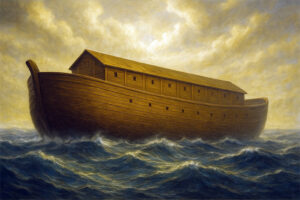
Noah’s Ark – Prehistory
Modern Container Ship (e.g., Maersk Triple-E Class)
- Length: ~1,312 feet (400 meters)
- Width: ~193 feet (59 meters)
- Height: ~240 feet (73 meters from keel to top of bridge)
- Decks: 10+ tiers of containers
TEU Capacity: ~18,000–24,000 containers
(1 TEU = 20-foot container)
Volume: Over 200,000 cubic meters, more than 4–5x the volume of Noah’s Ark.

Maersk-EEE Class Container Ship, 2025
Noah’s Ark was immense for its time — the largest wooden vessel ever described in the ancient world — by today’s standards, it’s about one-third the length and one-fifth the width of a modern container ship. Its proportions are considered remarkably seaworthy and hydrodynamically stable for surviving long-term floating.

From Ark to Armada: A Legacy of Carrying Life Across the Waters (rendered to scale)
6. The Wood in the Ark
In Genesis 6:14, God instructs Noah:
“Make yourself an ark of gopher wood; make rooms in the ark, and cover it inside and out with pitch.”
What is gopher wood?
- “Gopher wood” is a unique term in the Bible — it appears nowhere else.
Possible interpretations:
- Cypress: Many Bible translations render “gopher wood” as cypress, a durable, rot-resistant wood known in the ancient Near East.
- Cedar or pine: Both were used in shipbuilding and temple construction (for example, the Temple of Solomon used cedar).
- Laminated wood: Some scholars speculate “gopher” may refer not to a tree species, but to a construction method, such as laminated or squared timber.
Additionally, the ark was sealed with pitch (bitumen or resin), inside and out — a standard waterproofing material in ancient boatbuilding.
7. Other Historical & Cultural References
to Noah, the Flood, the Ark, and the Doves
The story of a great flood and a chosen survivor appears in many cultures and traditions worldwide. Some notable examples:
a. Mesopotamia Flood Stories (pre-dating Genesis)
Epic of Gilgamesh (c. 2100 BCE, Sumerian-Akkadian)
- The hero Utnapishtim is warned by the god Ea to build a boat before a divine flood.
- He loads it with animals and family, survives the flood, and sends out three birds:
- A dove (returns)
- A swallow (returns)
- A raven (does not return)
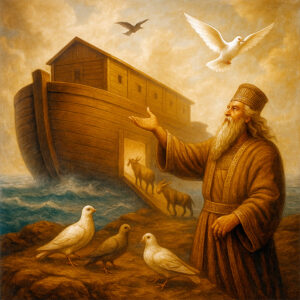
From the Epic of Gilgamesh
b. Atrahasis Epic (earlier version)
- A similar story of a flood sent to wipe out humanity, with one man chosen to build a boat.
These stories are older than the Genesis account and likely influenced or paralleled its development.
c. Account in The Qur’an
In the Islamic tradition, the story of the Great Flood is carried in the words of the Qur’an. The prophet Nūḥ calls his people to righteousness before the waters rise. He builds an Ark at God’s command.
- The flood comes as a punishment for disbelief.
- Noah’s son refuses to join the ark and perishes — a poignant detail not in the Bible.
- The ark comes to rest on Mount Judi (not Ararat).
- The story is in Surah 11 (Hud) and Surah 71 (Nuh).
The dove is not mentioned explicitly in the Qur’an.
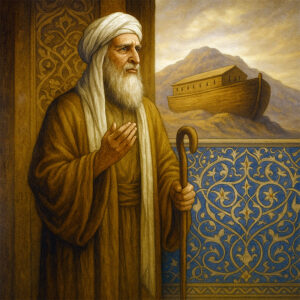
d. Global Flood Stories
Many cultures around the world preserve stories of a great flood:
- India: The story of Manu saved by a giant fish (a form of Vishnu) from a universal flood.
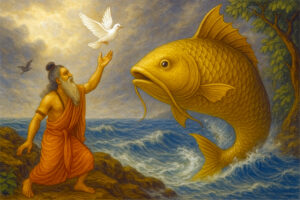
Sage of India, Manu, calls upon Vishnu to preserve the people from the Flood.
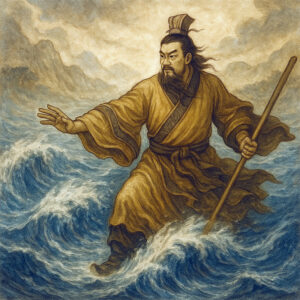
- China: Ancient flood legends involving the hero Yu the Great, who controls floodwaters.
Greek Myth: Deucalion and Pyrrha survive Zeus’s flood in a chest and repopulate the earth.
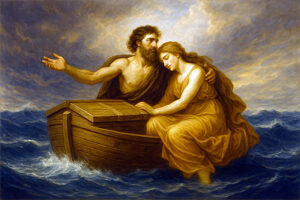
Greek heroes Deucaleon and Pyrrha give thanks for the protection of Heaven from the Flood.
- Indigenous Americas: Many tribes, including Hopi, Inca, and Aztec, tell of floods and floating canoes.
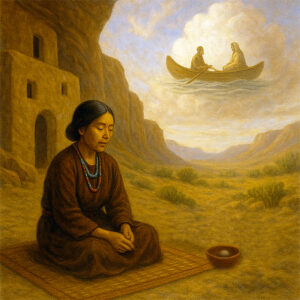
A Hopi woman recalls the ancestral story of the great Flood.
- Polynesia: Stories from Hawaii, Samoa, and Fiji speak of gods sending water to cleanse the earth.
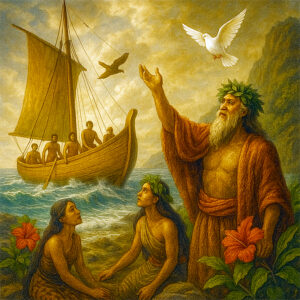
A Hawaiian kahuna celebrates the survival of his people as they arrive on the ‘aina again.
These stories may reflect real, ancestral memories of catastrophic floods — whether local or regional — that have now been woven into moral, cosmological, or spiritual narratives that shape our world today.
The symbol of the dove, the olive branch and the rainbow are universal signs of the commitment of humanity to peace.
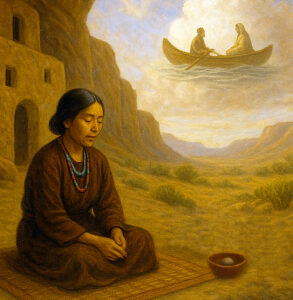
The Hopi story of the Flood, the story comes alive:
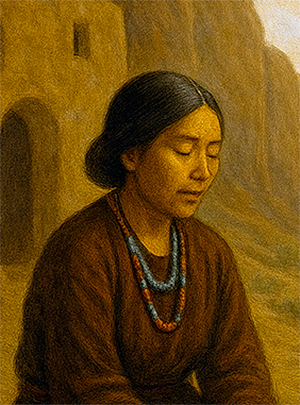
We imagine that, at the moment captured in this image, the Hopi woman is not merely thinking — she is remembering with her whole being:
“I am the breath between earth and sky.
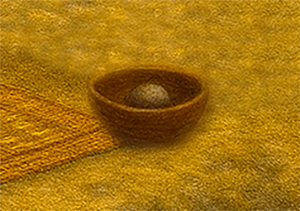
This stone carries the weight of stories too old for words,
smoothed by the hands of my grandmothers,
placed in this basket of time.
As I sit upon this woven ground,
the desert hushes so I may hear.
In the silence, I see them —
two figures, gliding in a canoe of cloud and memory,
riding the high waters when the world was washed clean.
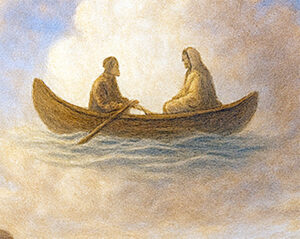 They are not far.
They are here.
I carry their breath in my lungs.
I carry their knowing in my bones.
I ask not who they are.
They are the ones who walked before.
They are the ones who became the path.
And now, as the world shifts again today,
The Ancestors remind me:
We are still afloat.
We are still remembering.
This stone, this breath and silence
is how the story continues.”
Ancestral Prayer of the Flood Memory
(Imagination of talk by a Hopi Elder, introducing the woman and her sacred vision)
Gather close, children of the mesas.
The fire is warm, and the stars are watching.
Tonight, we remember a journey before time.
Here sits the Daughter of Stone and Sky,
With the basket of woven memory beside her.
She listens not with ears,
But with her soul stillness.
She sees a canoe in the sky,
Carried on the breath of the ancestors.
Two of our people sailed the high waters,
Their hearts steady, their spirits strong.
The sacred mountain rose to welcome them.
The turtle held the land.
The people followed the corn.
And the breath of life began again.

We are here because they paddled.
We speak because they prayed.
We walk because they remembered.
Honor the vision.
Honor the stone.
Honor the basket.
Honor the flood.
When we dream tonight,
The canoe will come to us —
Carried on the cloud of memory,
Guided by those who still
whisper through the stars.
Leave a Reply